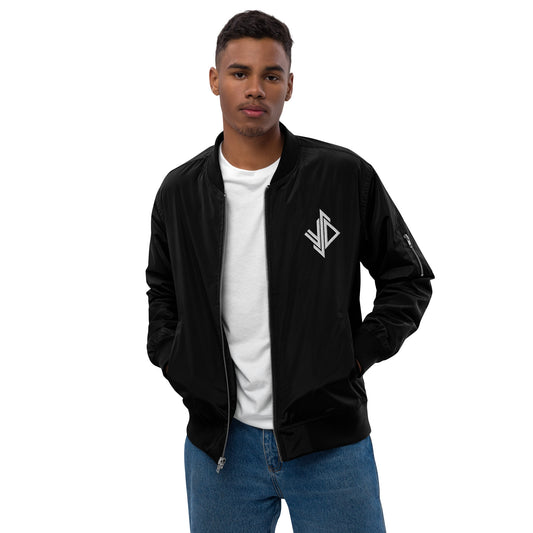

Dystopian Fashion: Beyond the Cyberpunk Basics
Dystopian Fashion - Cyberpunk gets most of the attention when people talk about dystopian style, but it's really just one branch of a much bigger tree. Post-apocalyptic survivalwear, brutalist minimalism, corporate dystopia, and biopunk all draw from the same well of "imagined broken futures" - and each one has a distinct visual language that goes well beyond neon and trench coats. If cyberpunk is starting to feel like the only dystopian aesthetic you know how to build an outfit around, this guide is the expansion pack.
Why Dystopian Fashion Is Bigger Than Cyberpunk
Cyberpunk imagines a specific kind of future: high tech, low life, neon signs reflecting off rain-slicked streets. It's a great look, but it's also become shorthand for "dystopian fashion" in general, which undersells how many other broken-future aesthetics exist and how differently they read on a body.
Dystopian fiction has never told just one story about the future. Some visions are about scarcity and survival. Some are about sterile, over-controlled societies where individuality has been engineered out. Some imagine a future where biology and technology have merged in ways that are equal parts beautiful and unsettling. Each of those stories has produced its own fashion vocabulary, and each one gives you a genuinely different set of tools to build outfits from - useful if you've built out a full cyberpunk capsule already and want to expand your range without repeating yourself.
The Literary and Cinematic Roots of Each Dystopian Style
Every one of these sub-aesthetics traces back to a specific strand of speculative fiction, and knowing the reference points makes it much easier to shop with intention instead of guessing at what "looks dystopian."
Post-apocalyptic survivalwear draws from wasteland fiction - the Mad Max films, The Road, and decades of survival games and comics that imagine a world after infrastructure collapses. The throughline is always the same: clothing has to work, because nothing gets replaced easily.
Corporate dystopia has roots in mid-century speculative fiction like Brave New World and THX 1138, where the threat isn't collapse but control - a future so orderly and institutionalized that individuality itself becomes suspicious. The fashion response is control expressed through uniformity.
Biopunk is the newest of the four, growing out of 1990s and 2000s speculative fiction and film that imagined biotechnology, not computing, as the defining technology of the future - genetic modification, synthetic organisms, bodies altered from the inside rather than augmented from the outside.
Brutalist minimalism borrows less from fiction and more directly from architecture - the raw concrete, unornamented mass of Brutalist buildings from the mid-20th century, later adopted by fashion and film as visual shorthand for cold, imposing futures.

Post-Apocalyptic Survivalwear: Function as Aesthetic
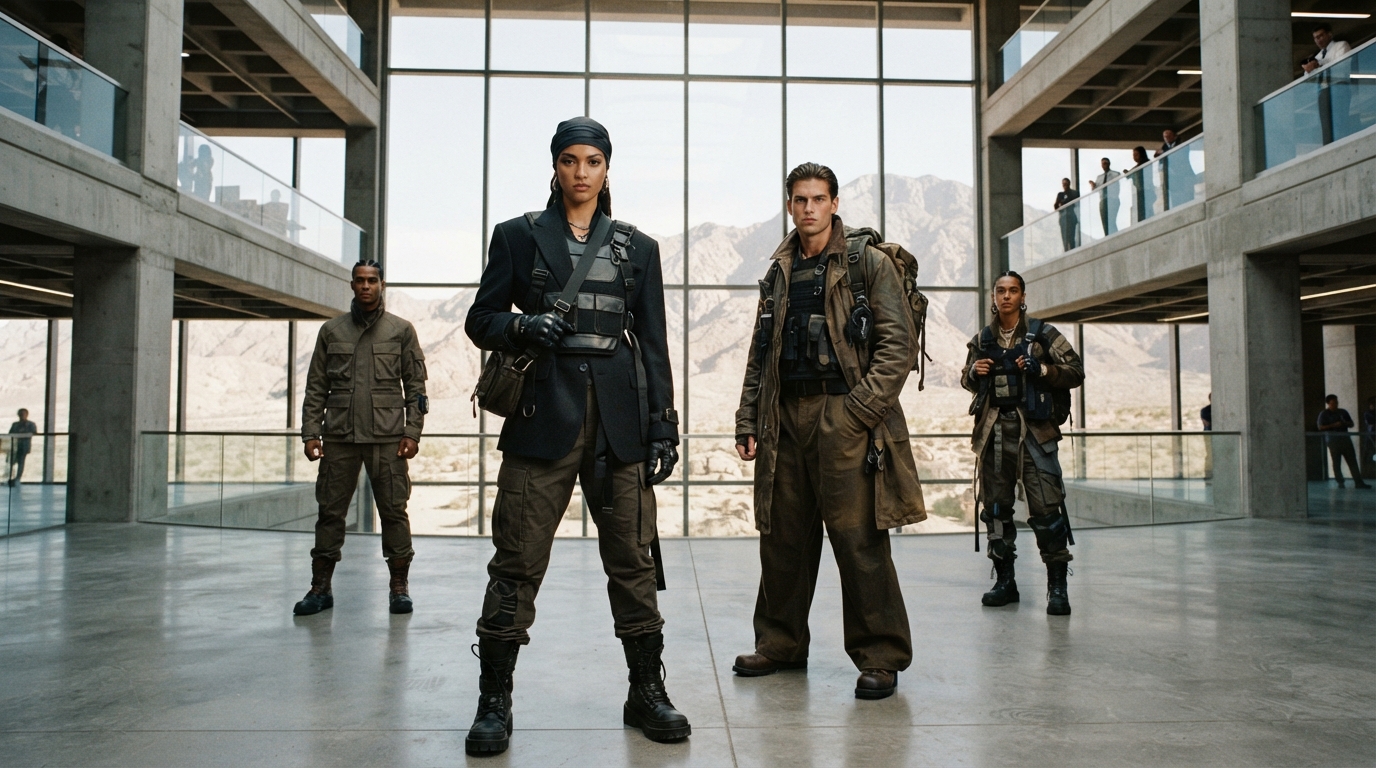
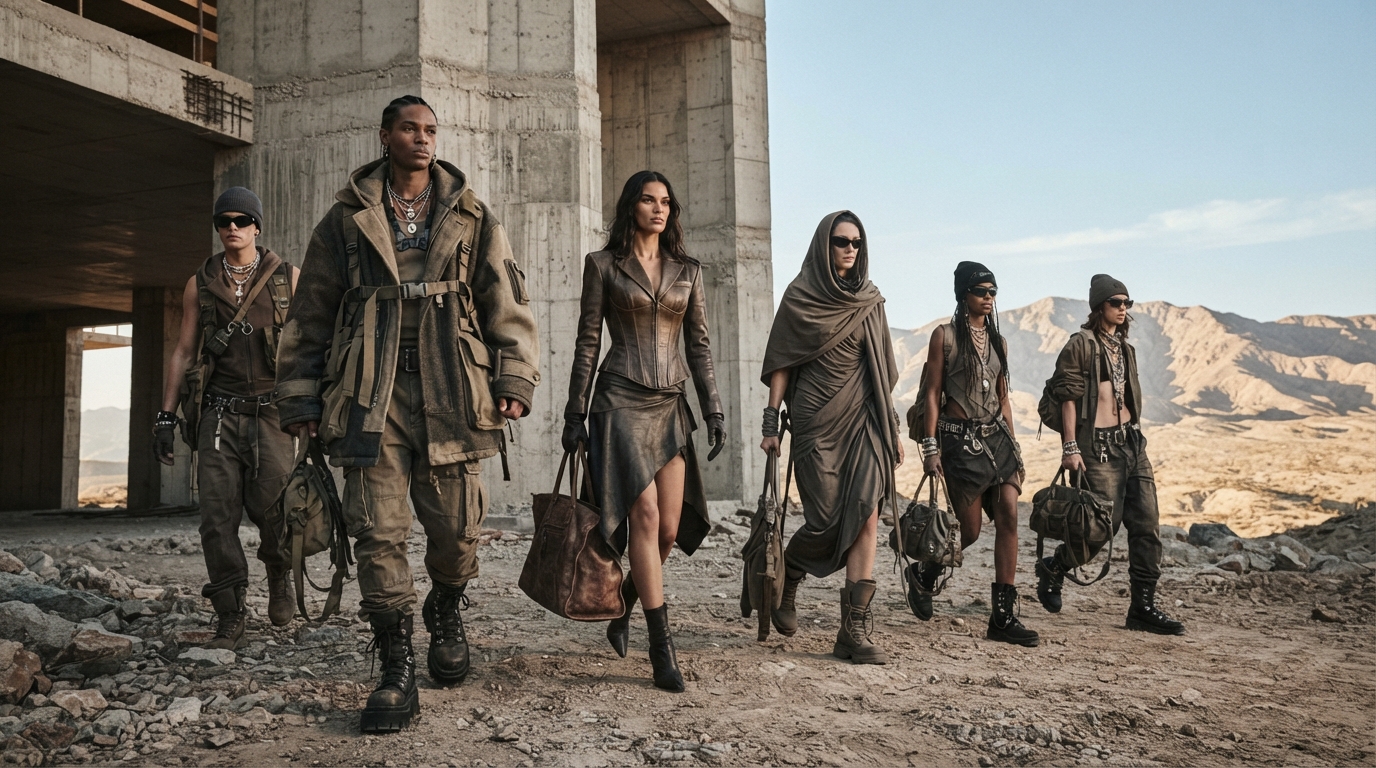
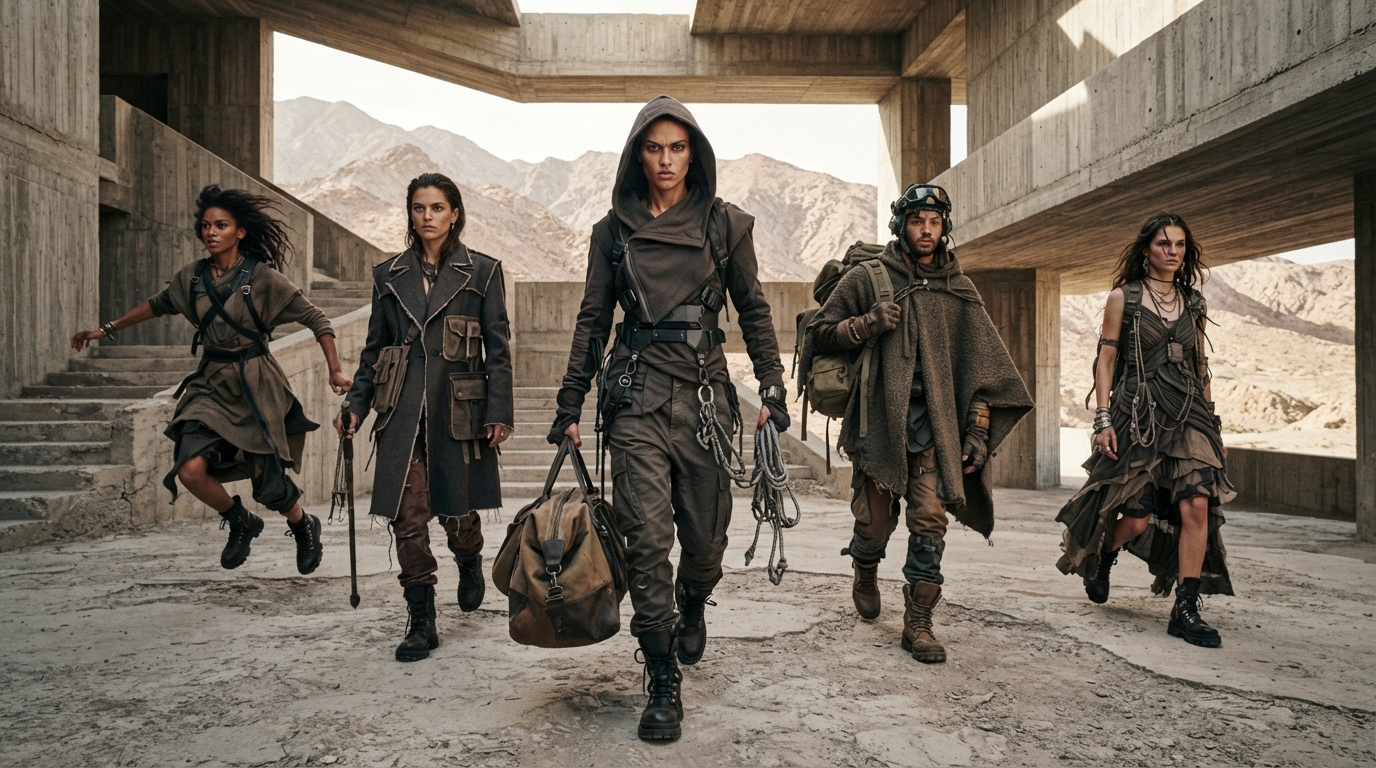
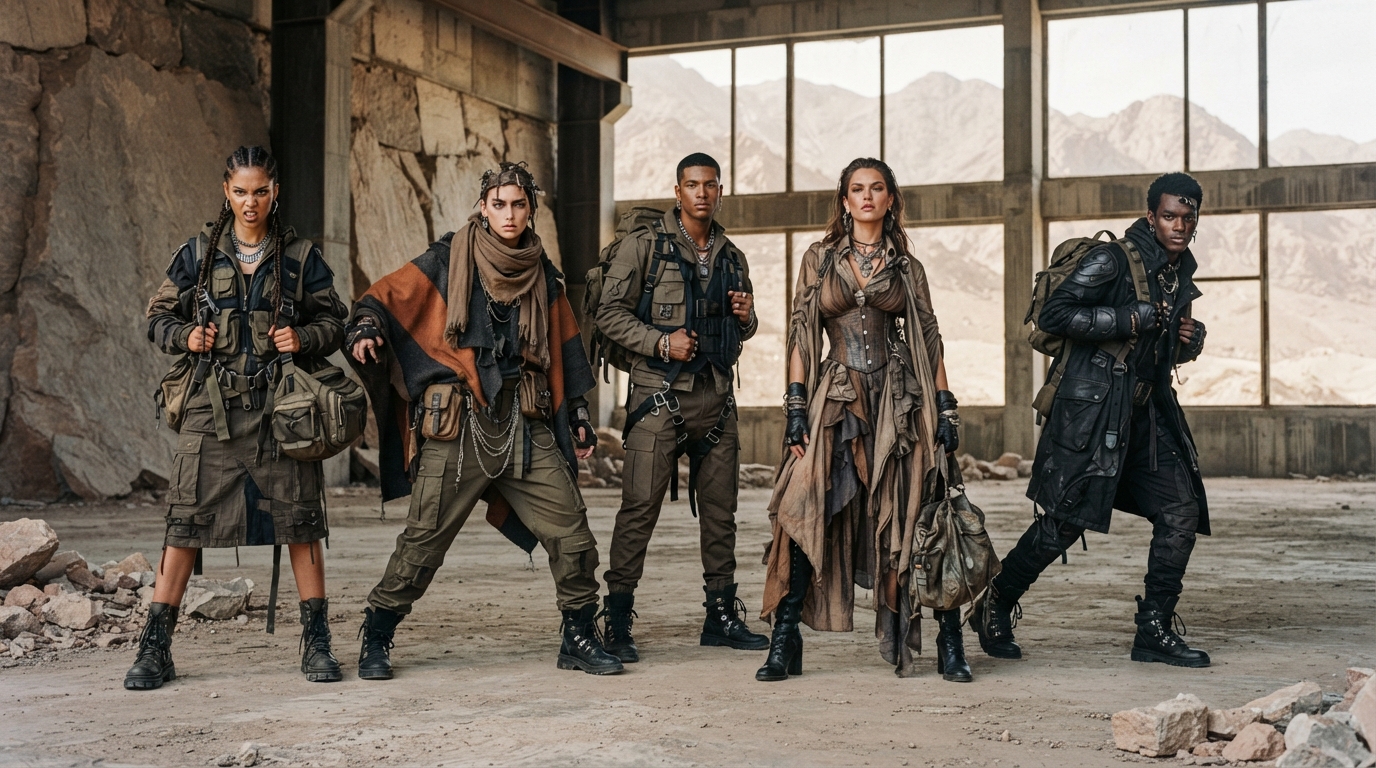
This is the "the infrastructure is gone, so everything I own has to work" look. Think patched and repaired garments, mismatched layers, visible mending, and a color palette dictated by whatever materials would actually survive - dusty neutrals, faded military colors, rust and ash tones rather than the saturated blacks of cyberpunk.
Key pieces: distressed and deliberately repaired outerwear, layered utility vests, fingerless gloves, scarves or wraps used as multi-purpose gear, and boots built for rough terrain rather than a clean silhouette. Texture does more work here than color - canvas, raw denim, worn leather, and anything that looks like it's been through something.
The tell that separates this from costume: restraint in the "damage." A single strategically placed patch or a genuinely worn hem reads as authentic; deliberately shredding five different garments in the same outfit reads as Halloween.
Where to find it: military surplus and workwear brands are the most reliable source for authentic survivalwear pieces, since they're designed to survive real wear rather than mimic it. A canvas work jacket or a genuine utility vest will always read more convincing than a pre-distressed fast-fashion version.
Corporate Dystopia: The Sterile, Controlled Future
Where cyberpunk is chaotic and lived-in, corporate dystopian fashion is the opposite - clean lines, monochrome or near-monochrome palettes, and a slightly uncanny uniformity that suggests a future where individuality has been smoothed away by institutions. Think of it as the fashion equivalent of a fluorescent-lit office in a future nobody chose.
Key pieces: structured, minimal outerwear with no visible branding, high necklines, matching separates in a single tonal family (grey-on-grey, off-white-on-off-white), and clean, almost architectural silhouettes. Accessories are minimal and utilitarian rather than decorative - a single ID lanyard or badge reads more true to the aesthetic than a chain necklace.
Why it works as a contrast piece: if your closet already leans toward loud, detailed cyberpunk pieces, one or two corporate-dystopia items give you a genuinely different mode to reach for - sharp and unsettling instead of gritty and tactical.
Where the effect breaks down: the moment you add a graphic tee, a chain, or a distressed jacket into a corporate-dystopia outfit, the whole effect collapses. This aesthetic depends on everything staying quiet at once - it's one of the few dystopian styles where a single loud piece ruins the entire look rather than just competing with it.
Biopunk: Where Technology Gets Organic
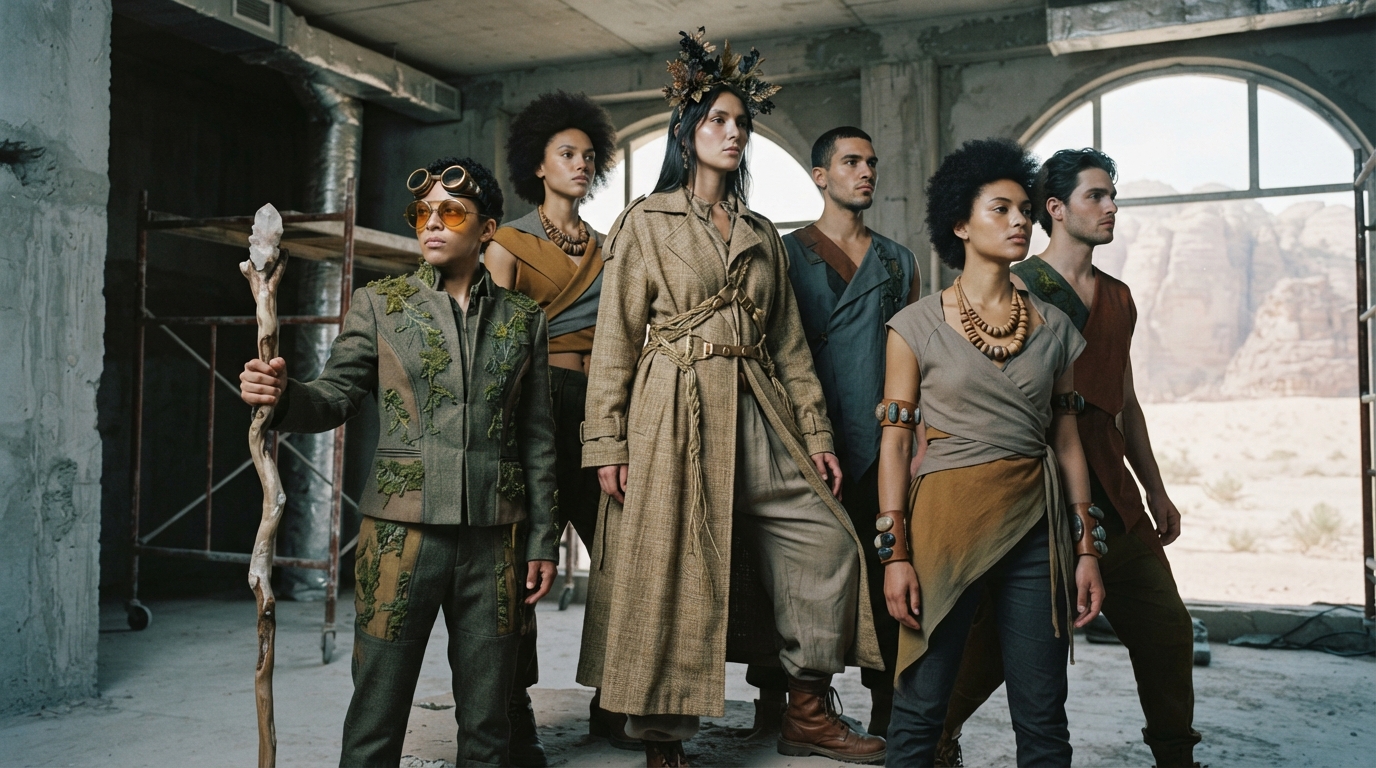
Biopunk imagines a future shaped by biotechnology rather than mechanical tech - genetic engineering, synthetic organisms, and a visual language built on organic shapes rather than hard edges and circuitry. Fashion-wise, this translates into flowing, almost cellular silhouettes, iridescent or translucent materials, and prints that look more like magnified tissue or bioluminescent patterns than machinery.
Key pieces: draped or asymmetric layers instead of structured tailoring, fabrics with a subtle sheen or color-shift effect, and graphic prints built around organic patterns - think coral, fungal networks, or cellular structures - rather than the circuitry and typography common in cyberpunk graphics.
How to introduce it without a full overhaul: one draped or asymmetric outer layer, or a single graphic tee with an organic rather than mechanical print, is enough to nod at the aesthetic without committing to an entirely different wardrobe.
A note on color: biopunk is one of the only dystopian sub-aesthetics where unusual color actually belongs. Iridescent, color-shifting, or unexpectedly bright organic tones (think deep violet, bioluminescent teal) read as intentional here in a way they wouldn't in a cyberpunk or brutalist outfit.
Brutalist Minimalism: Dystopia Through Absence
Not every dystopian future is loud. Brutalist fashion draws from the architecture it's named after - raw, unornamented, monolithic - and translates that into clothing with almost no decorative detail at all. It's the aesthetic of a future that's stripped everything down to function and left it there.
Key pieces: oversized, unstructured outerwear in a single flat color, minimal or no visible hardware, and silhouettes that read as heavy and deliberate rather than tailored. Where cyberpunk uses exposed hardware to suggest function, brutalist minimalism suggests function through sheer mass and simplicity.
The mood it sets: this is the aesthetic to reach for when you want "dystopian" to read as cold and imposing rather than scrappy or tech-forward. It pairs surprisingly well as a base layer under a more detailed cyberpunk jacket, letting the outerwear carry all the visual complexity.
Seasonal Considerations for Each Dystopian Sub-Aesthetic
Just like a cyberpunk capsule, these other dystopian styles need small adjustments across seasons rather than a full rebuild.
Survivalwear actually gets easier in colder months, since layering is already part of the aesthetic's logic - a base layer, a worn mid-layer, and a distressed outer piece all read as authentic rather than excessive. In warmer weather, drop to a single worn utility layer over a plain base and let accessories like a canvas bag carry the reference.
Corporate dystopia holds up well year-round since it's built on structured tailoring rather than heavy fabric - a lightweight monochrome set works in summer just as well as a heavier version works in winter, as long as the silhouette and restraint stay consistent.
Biopunk benefits from lighter, more fluid fabrics in warmer months, since draped and asymmetric silhouettes naturally suit lighter materials. Colder months are where a structured, color-shifting outer layer gets to do more of the visual work.
Brutalist minimalism is naturally suited to colder weather, given its reliance on heavy, oversized outerwear - but a single boxy, unstructured piece in a lightweight fabric can carry the same mood into summer without the bulk.
Mixing Dystopian Sub-Aesthetics Without Losing Cohesion
You don't have to pick one lane forever, but mixing sub-aesthetics inside a single outfit takes a bit more care than staying within one. A few ground rules keep the mix from reading as random:
Let one aesthetic lead. Pick a primary reference - cyberpunk, survivalwear, corporate dystopia, biopunk, or brutalist minimalism - and treat the others as accents rather than equal partners. An otherwise cyberpunk outfit with one brutalist outer layer reads as intentional; an outfit split evenly across three aesthetics reads as confused.
Keep the palette anchored. Most dystopian sub-aesthetics share a preference for muted or monochrome bases. As long as your base layers stay in that family, you can swap in accent pieces from different sub-aesthetics without the outfit falling apart visually.
Match the mood, not just the color. A biopunk piece with soft, organic draping will fight against a stiff, structured brutalist jacket even if the colors match. Pay attention to silhouette and texture, not just palette, when combining pieces from different dystopian styles.
Use footwear and accessories as the bridge. When two sub-aesthetics feel hard to combine directly, a neutral accessory - a plain black bag, simple boots - can act as a visual bridge between them, since it doesn't pull strongly toward either style's specific silhouette language.
Building a Small Dystopian Capsule Beyond Cyberpunk
Dystopian Fashion - If you want to start experimenting without overhauling your whole wardrobe, a small, deliberate set of additions goes a long way:
One survivalwear piece - a distressed utility vest or a well-worn jacket - to add texture and a scrappier mood to outfits that would otherwise read as too clean.
One corporate-dystopia piece - a minimal, structured jacket or a monochrome set - to give you a sharper, quieter mode for days when full cyberpunk feels like too much.
One biopunk or brutalist accent - a single graphic tee or an oversized minimal outer layer - to introduce a genuinely different mood without needing a whole new wardrobe built around it.
One footwear or accessory swap - a pair of boots or a bag chosen for one of these sub-aesthetics specifically - is often the lowest-risk way to test a new direction before investing in outerwear, since it's the piece you're least likely to regret if the style doesn't end up sticking.
Three or four pieces, chosen deliberately, are enough to give an existing cyberpunk-based wardrobe real range without diluting what already works.
A note on pacing: treat this the same way you'd treat building any capsule - one piece at a time, worn a few times before adding the next, rather than a single large purchase across all four sub-aesthetics at once. It's much easier to tell whether a survivalwear jacket actually earns its place in your wardrobe after wearing it a handful of times than it is to guess in advance.
Common Mistakes When Branching Out From Cyberpunk
Treating every dystopian sub-aesthetic like cyberpunk with different colors. Each style has its own silhouette logic, not just a different palette. A survivalwear piece in cyberpunk black doesn't automatically read as cyberpunk if the cut and texture are pure post-apocalyptic.
Overcommitting to a niche reference all at once. Buying five biopunk pieces in one order is a much bigger risk than adding one and seeing how it works with what you already own. Dystopian sub-aesthetics are worth testing the same way you'd test any new style direction.
Forgetting that restraint is part of the language. Corporate dystopia and brutalist minimalism in particular lose their impact fast if you add too many accessories or graphic details. The starkness is the point.
Assuming every dystopian style needs dark colors. Biopunk in particular breaks this rule on purpose, and even survivalwear leans toward faded, dusty tones rather than pure black. Defaulting to all-black for every sub-aesthetic flattens the differences that make each one distinct.
Frequently Asked Questions
Do I need a completely different wardrobe to try these other dystopian aesthetics?
No. A single well-chosen piece - a distressed jacket, a monochrome set, an organic-print tee - is usually enough to introduce a new sub-aesthetic into an existing cyberpunk-based wardrobe.
Which dystopian sub-aesthetic pairs easiest with cyberpunk?
Post-apocalyptic survivalwear tends to blend most naturally, since both share dark, muted palettes and utilitarian silhouettes. Corporate dystopia and brutalist minimalism work better as deliberate contrast pieces than as blends.
Is biopunk fashion hard to find or expensive?
Not necessarily - the easiest entry point is a single graphic tee or accessory with organic, cellular-style prints rather than a full garment built around iridescent or translucent fabric.
How do I keep a mixed dystopian outfit from looking random?
Let one aesthetic lead the outfit and treat pieces from other sub-aesthetics as accents. Keeping the base palette consistent across all the pieces also helps tie a mixed outfit together.
Which dystopian sub-aesthetic is the most beginner-friendly?
Post-apocalyptic survivalwear is usually the easiest starting point, since workwear and military surplus pieces that fit the look are widely available and don't require sourcing anything highly specific.
Final Thoughts
Cyberpunk is a great foundation, but it's not the whole dystopian fashion story. Post-apocalyptic survivalwear, corporate dystopia, biopunk, and brutalist minimalism each bring something genuinely different to the table - texture, starkness, organic shape, sheer scale - and a few deliberate additions from these other sub-aesthetics can give an existing wardrobe a lot more range without losing the cohesive, intentional feel that makes dystopian style work in the first place.